
Want to start exercising but don’t have gym equipment? Good news! You can get fit using only your body. No machines, no weights, no problem.
Bodyweight training is an effective way to enhance your fitness without extra equipment.
The beauty of bodyweight training is that it requires no equipment, making it accessible to everyone.
Bodyweight training is versatile and can be tailored to suit different fitness levels.
Many people find that bodyweight training improves their overall strength and endurance.
These 5 simple exercises work your whole body. You can do them at home, in a park, or in a hotel room. Let’s start!
By incorporating bodyweight training into your routine, you can achieve impressive results.
Bodyweight training not only builds muscle but also enhances balance and coordination.
Engaging in bodyweight training can lead to improved body composition over time.
Why Bodyweight Training Works
Before we begin, here’s why bodyweight exercises are perfect for beginners:
✓ Free – No gym membership needed
✓ Anywhere – Exercise at home, outside, or while traveling
✓ Safe – Lower risk of injury than heavy weights
✓ Effective – Build real strength and fitness
✓ Quick – This workout takes only 15-20 minutes
The 5 Best Exercises for Beginners
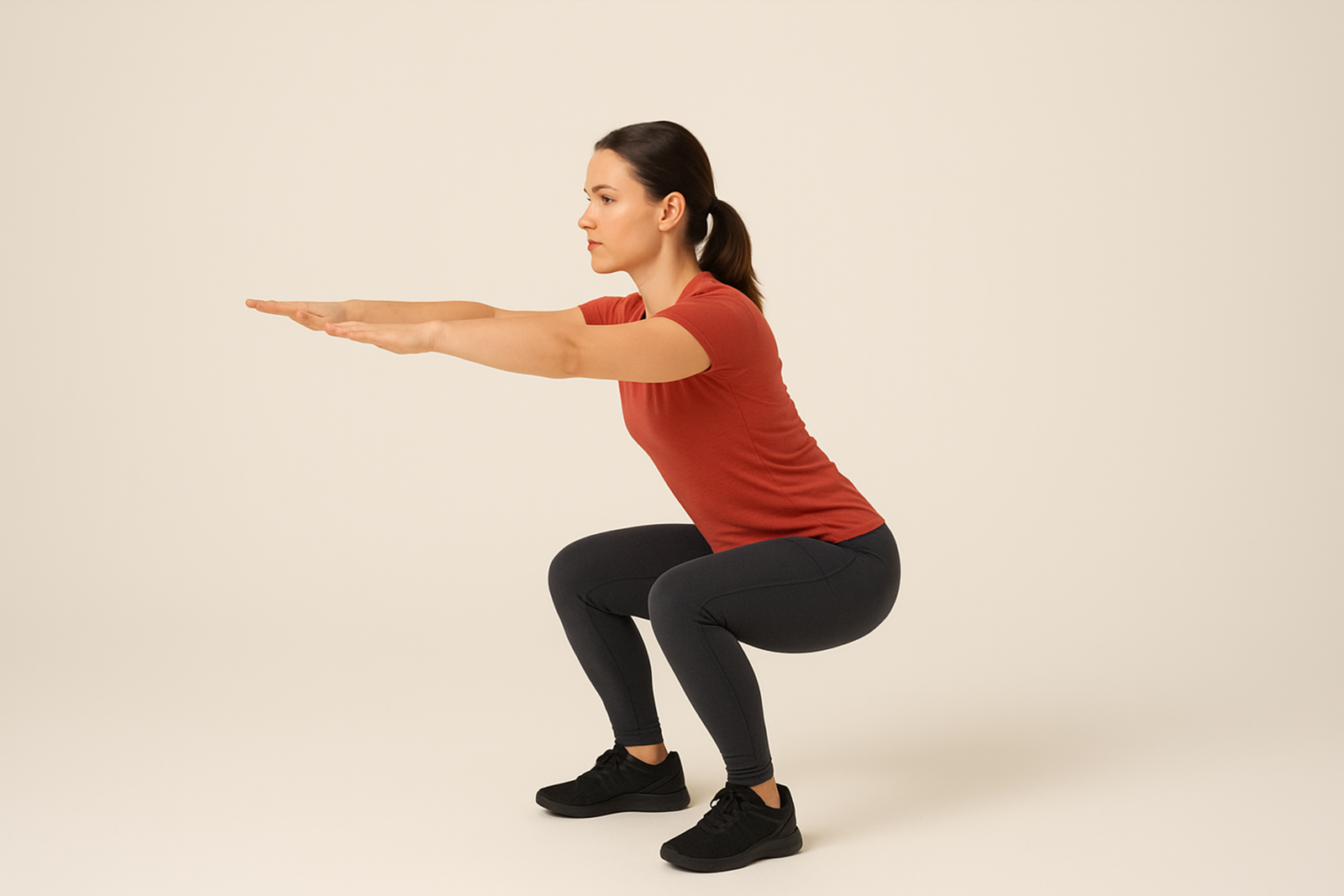
1. Squats (For Legs and Butt)
What it does: Makes your legs and butt stronger.
How to do it:
- Stand with feet shoulder-width apart (about 40-50 cm)
- Keep your chest up and look forward
- Push your hips back like sitting in a chair
- Go down until your legs make a 90-degree angle
- Push through your feet to stand up
As you progress, you’ll find that bodyweight training can enhance your overall athleticism.
Easy tip: Put a chair behind you. Touch it lightly with your butt, then stand up.
Common mistake: Don’t let your knees go past your toes.
Many beginners start their fitness journey with bodyweight training before progressing to weights.
Breathe: Breathe in when going down, breathe out when standing up.
2. Knee Push-Ups (For Chest, Shoulders and Arms)
What it does: Builds upper body strength.
How to do it:
- Get on your hands and knees
- Put your hands on the floor, slightly wider than your shoulders
- Make a straight line from your head to your knees
- Bend your elbows and lower your chest toward the floor
- Push back up
Easy tip: If too hard, do them against a wall while standing.
When to progress: When you can do 12 knee push-ups easily, try regular push-ups (on your toes).
Common mistake: Don’t let your back bend or your hips drop.
Breathe: Breathe in going down, breathe out pushing up.
3. Glute Bridge (For Butt and Back of Legs)
What it does: Strengthens your butt and protects your lower back.
How to do it:
Bodyweight training exercises can be adjusted to increase or decrease difficulty based on your ability.
Using your own body weight for resistance in bodyweight training is both functional and effective.
As you get stronger, you can modify bodyweight training exercises to keep challenging yourself.
- Lie on your back
- Bend your knees, feet flat on floor (hip-width apart)
- Push through your feet and lift your hips up
- Make a straight line from shoulders to knees
- Squeeze your butt at the top for 2 seconds
- Lower down slowly
For many, the convenience of bodyweight training makes it easier to stay consistent.
Focus: Feel it in your butt, not your lower back.
Common mistake: Don’t arch your back too much.
Breathe: Breathe out when lifting up, breathe in when lowering down.
4. Plank (For Core and Stability)
What it does: Makes your stomach muscles strong and improves posture.
How to do it:
- Get on your forearms and toes
- Keep elbows under your shoulders
- Make your body straight like a board
- Squeeze your stomach and butt
- Hold this position
Easy tip: Too hard? Do it on your knees instead of your toes.
Common mistake: Don’t let your hips drop down or stick up.
Breathe: Keep breathing normally – don’t hold your breath!
5. Bird-Dog (For Balance and Core)
What it does: Improves balance and core strength.
How to do it:
- Start on hands and knees
- Keep your back flat (neutral spine)
- Lift your right arm forward AND left leg backward at the same time
- Hold for 2 seconds
- Return to start
- Switch sides (left arm, right leg)
Focus: Move slowly. Don’t let your hips twist.
Easy tip: Just lift one arm OR one leg if both is too hard at first.
Breathe: Breathe out when lifting, breathe in when lowering.
Your Complete Beginner Workout Plan
Total Time: 15-20 minutes
Step 1: Warm-Up (5 minutes)
- March in place: 1 minute
- Arm circles (big circles with arms): 30 seconds each direction
- Leg swings: 20 swings each leg
- Gentle jumping jacks or step-touches: 1 minute
Step 2: The Main Workout
Do each exercise in order. That’s 1 round. Rest 60-90 seconds after each round.
| Exercise | How Many | Tips |
|---|---|---|
| Squats | 12 times | Go slow |
| Knee Push-Ups | 8-10 times | Keep back straight |
| Glute Bridges | 12 times | Squeeze butt at top |
| Plank | 30 seconds | Don’t hold breath |
| Bird-Dog | 8 each side | Move slowly |
Complete 2 rounds (do all exercises twice)
Step 3: Cool-Down (5 minutes)
Stretch these muscles (hold each stretch for 30 seconds):
- Legs (stand and pull foot to butt)
- Chest (clasp hands behind back)
- Shoulders (pull one arm across body)
- Lower back (hug knees to chest while lying down)
Workout Schedule: How Often Should You Train?
Best plan for beginners:
- Do this workout 3 times per week
- Take at least 1 rest day between workouts
- Example: Monday, Wednesday, Friday
Example week:
- Monday: Workout
- Tuesday: Rest or light walk
- Wednesday: Workout
- Thursday: Rest or light walk
- Friday: Workout
- Weekend: Rest or light activity
Bodyweight training can be integrated into any routine, whether at home or outdoors.
Track Your Progress
Taking the plunge into bodyweight training will set a strong foundation for future workouts.
Write down your workouts! This keeps you motivated.
Simple tracking method:
Week 1:
- Date: _______
- Rounds completed: 2
- How I felt: _______
When to increase difficulty:
After 2-3 weeks, if the workout feels easier:
- ✓ Add 1 more round (do 3 rounds instead of 2)
- ✓ Do more reps (15 squats instead of 12)
- ✓ Hold plank for 45 seconds instead of 30
- ✓ Rest only 45 seconds between rounds
Common Beginner Questions
Q: I can’t do 8 push-ups. What should I do?
A: Do as many as you can (even if it’s just 3-4). Rest 10 seconds, then do a few more. You’ll get stronger quickly!
Q: My muscles are sore the next day. Is this normal?
A: Yes! This is called DOMS (Delayed Onset Muscle Soreness). It means your muscles are getting stronger. It will hurt less after a few weeks.
Bodyweight training is a fantastic way to build both strength and endurance simultaneously.
Q: Should I exercise if I’m sore?
A: Light exercise is okay, but listen to your body. If very sore, rest another day.
Q: I don’t feel anything during the exercises. Am I doing it wrong?
A: You should feel your muscles working. Check your form – maybe watch video tutorials or use a mirror.
Q: How long until I see results?
A: Most people feel stronger in 2-3 weeks. You’ll see visible changes in 6-8 weeks with consistent training.
Important Safety Tips
⚠️ Stop if you feel pain (not to be confused with muscle burn – pain means injury)
⚠️ Never skip warm-up – it prevents injuries
⚠️ Quality over speed – do exercises correctly, not quickly
⚠️ Stay hydrated – drink water before and after
⚠️ Eat properly – your body needs good food to build muscle
Ready to Start Your Fitness Journey?
With bodyweight training, the options for variations are nearly endless, keeping workouts fresh.
This simple workout is perfect for beginners. You need only:
- 15-20 minutes
- A small space (2×2 meters)
- Your body
- Motivation!
Remember: Everyone starts somewhere. Don’t compare yourself to others. Focus on being better than yesterday.
Start today with just 1 round. Add more next week. Small steps lead to big changes!
Want more fitness tips and workout guides? Follow our blog for weekly beginner-friendly exercise routines and healthy living advice.
Have you tried this workout? Share your experience in the comments below! What was the hardest exercise for you?
Disclaimer: Consult your doctor before starting any new exercise program, especially if you have health conditions or injuries.
Bodyweight training can help improve your agility, making it a great addition to any fitness routine.
Moreover, bodyweight training can boost your confidence as you notice your progress.
Adding bodyweight training to your regimen can lead to a more toned and defined physique.
Ultimately, bodyweight training offers flexibility and customization for every fitness level.
Bodyweight training requires minimal space and can be done anywhere, making it ideal for busy schedules.
Over time, bodyweight training can lead to remarkable physical transformations.
Remember, bodyweight training is not just for beginners; it’s effective for all fitness levels.
Incorporating bodyweight training into your routine can lead to improved cardiovascular health.