

Starting a fitness journey is honestly pretty easy. You get excited, buy some new gear, maybe sign up for a gym membership. The first week feels great.
Staying consistent with your workouts? That’s where most people completely fail. And it’s not because they’re lazy or don’t care about results. It’s because they fundamentally misunderstand how motivation actually works in the human brain, especially when it comes to achieving fitness consistency.
Achieving fitness consistency often requires a mindset shift. Embrace the idea that fitness consistency is not solely about motivation but about making it a part of your identity.
If you understand the real psychology behind motivation, you stop depending on feeling motivated all the time and start building something much stronger and more reliable: discipline and identity.
Understanding the importance of fitness consistency can lead to a more fulfilling fitness journey.
Let’s break down how this actually works.
Motivation Is Just a Feeling, and Feelings Always Fade
Many successful individuals attribute their achievements to their fitness consistency, which is built over time.
Most people genuinely believe they need to feel motivated before they can work out. But motivation is purely emotional, and emotions are temporary by nature.
This understanding of fitness consistency allows for long-term success in workouts.
You feel super motivated right after watching an inspiring fitness video, seeing someone’s transformation photos on Instagram, or buying new gym clothes that make you feel ready. But that excited feeling fades within a few days, sometimes even hours.
If your entire fitness routine depends on emotional motivation, it will collapse the moment life gets busy, stressful, or boring. And life always gets busy and stressful eventually.
Adopting fitness consistency as part of your life will lead to a healthier lifestyle.
Here’s the truth that successful people understand: they don’t rely on motivation at all. They rely on systems and routines that work regardless of how they feel.
Identity Is Way Stronger Than Motivation
Focus on creating small habits that reinforce your fitness consistency each day.

Here’s a powerful psychological concept that most people miss completely. People naturally act in alignment with who they believe they are deep down.
If you tell yourself and others “I’m trying to work out more,” you’ll behave inconsistently because you haven’t actually changed your identity. You’re still the same person just trying something new.
But if you genuinely start saying “I am someone who trains regularly,” your brain automatically starts looking for proof and evidence to support that new identity. You start making different choices without even thinking about it.
Instead of constantly chasing motivation, work on shifting your identity first. Don’t focus your mental energy on outcome goals like “I want to lose 10 kilograms in three months.” Focus instead on identity statements like “I am becoming a disciplined person” or “I am someone who shows up for themselves.”
Identity change at the core level creates long-term consistency that lasts for years, not just weeks.
Small Wins Build Dopamine Momentum in Your Brain
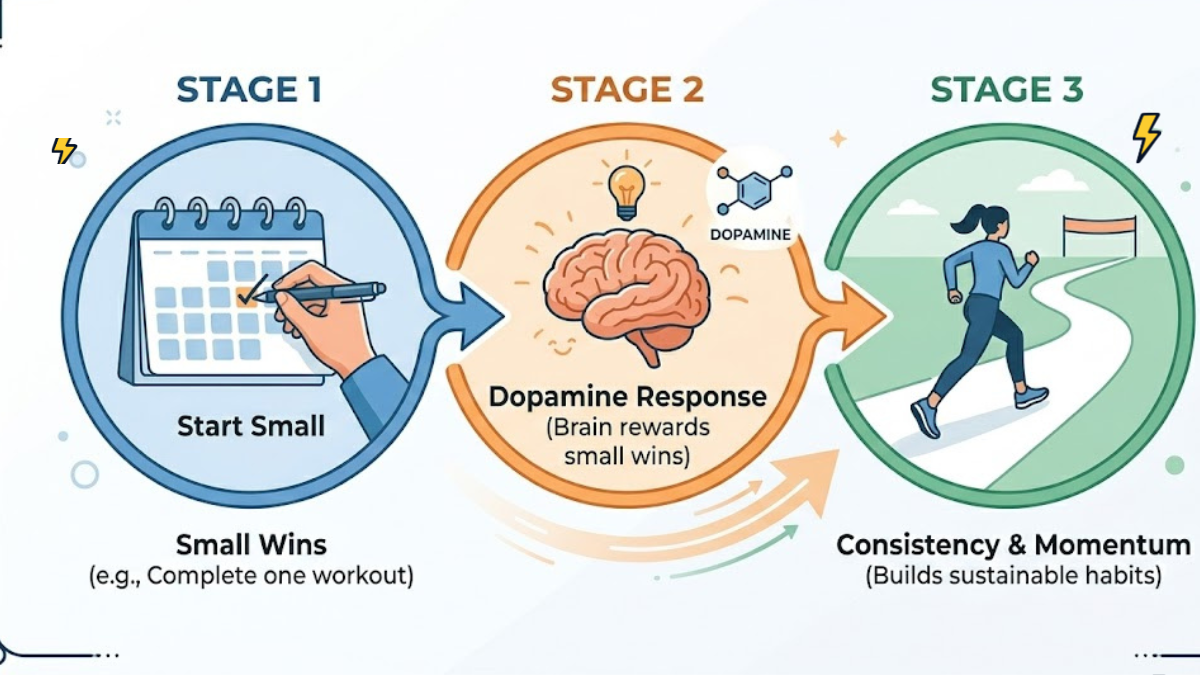
Remember that taking action is crucial for developing fitness consistency, rather than waiting for motivation.
Your brain runs on dopamine, which is the chemical directly linked to reward, pleasure, and motivation. Understanding this helps you work with your brain instead of against it.
But here’s the common mistake most beginners make. They set absolutely huge goals right away like losing 20 kilograms, getting visible abs in two months, or training six days every single week without fail.
Big goals like this feel overwhelming to your brain. When progress feels slow or invisible, your dopamine levels drop significantly, and so does your motivation to continue.
Instead of huge goals, focus on creating small wins that happen quickly. Complete three workouts this week. Drink enough water today. Add just one extra rep to your sets. Walk 8,000 steps instead of your usual 6,000.
Small achievements create quick dopamine hits in your brain. Those dopamine hits build momentum. And momentum naturally builds consistency over time without you having to force it.
Design your environment to support your fitness consistency, making it easier to achieve your goals.
Action Creates Motivation, Not the Other Way Around
This is genuinely one of the most misunderstood ideas in all of fitness psychology. Most people think the process works like this: first you feel motivated, then you take action.
But psychological research shows the opposite is actually true. Action creates motivation, not the other way around.
When you start with just a five-minute warm-up, do just one single set of an exercise, or show up to the gym even when you’re tired, your brain starts naturally rewarding that behavior with feel-good chemicals.
After you begin moving, motivation often appears out of nowhere. It sounds backward, but it’s how human psychology actually works.
So stop waiting around to feel ready or motivated. Start first, even if it’s tiny. Feel motivated second as a result of starting.
Your Environment Shapes Behavior More Than Willpower
Your ability to maintain fitness consistency will determine how successful you are in the long run.

Fitness consistency is achieved through discipline and daily practice, regardless of how you feel.
Here’s a truth that might hurt a little: you probably don’t lack discipline or willpower. You lack the right environment that makes fitness easy instead of hard.
If your workout clothes are buried at the bottom of your closet and hard to find, if your equipment is shoved in a corner covered in other stuff, if your workout schedule is completely random and unplanned, then your brain will always choose the easier option, which is usually doing nothing.
Make fitness physically easier by changing your environment. Keep your workout gear visible where you see it every day. Prepare your clothes the night before so there’s no decision to make in the morning. Schedule your workouts in your calendar like they’re important meetings you can’t miss. Remove distractions during your training time by putting your phone in another room.
Reduce the friction and barriers to starting. Increase your chances of success by making good choices the easy default option.
Consistency Beats Intensity Every Single Time
Psychological research on habit formation shows that habits form through repetition and frequency, not through intensity or effort level.
Training three times per week consistently for one full year will give you dramatically better results than training six times per week for just one month before burning out completely.
Building a strong sense of fitness consistency will empower you to overcome challenges.
The human brain builds lasting habits through repeated frequency, not through occasional bursts of extreme effort. Start with small, manageable commitments. Repeat them often without skipping. Grow gradually as they become easier.
With fitness consistency, you will see improvements in your physical and mental health.
Stop Relying on Motivation and Build Discipline Instead
Incorporating fitness consistency into your life requires small, sustainable changes.
Motivation is great for getting you started on day one. But discipline is what keeps you going on day 100 when the excitement is completely gone.
Ultimately, your journey to fitness consistency will lead you to greater health and well-being.
By mastering the concept of fitness consistency, you create a solid foundation for long-term health.
Your commitment to fitness consistency will enhance both your physical and mental resilience.
Embrace daily actions that contribute to your fitness consistency, and watch your progress unfold.
Discipline is simply doing what you said you would do, even when you absolutely don’t feel like doing it. And discipline isn’t some magical trait that some people are born with and others aren’t. It’s a skill you build through practice.
Every single time you show up to train even though you’re tired, work out even though you’re stressed, or finish your session anyway when you wanted to quit halfway through, you’re actively building mental strength and discipline.
It gets easier each time you do it because you’re training your brain, not just your body.
Making It Practical in Your Life

So how do you actually apply this psychology to your real life? Start by picking one identity statement that resonates with you. “I am someone who takes care of their health” or “I am a person who keeps commitments to themselves.”
Then create one tiny habit that proves that identity. Maybe it’s putting on your workout gear every morning at the same time, even if you don’t work out yet. Maybe it’s doing just five push-ups every day without fail.
Design your environment to support this tiny habit. Remove barriers. Make it visible. Schedule it. Then do it consistently for 30 days straight, no matter what.
After 30 days, that habit will feel automatic. Your identity will have shifted slightly. Your brain will be craving the dopamine hit from completing it. Then you can add another small habit on top.
Final Thoughts
Consistency in fitness genuinely isn’t about hype or excitement. It’s not about following extreme programs that promise results in 30 days. It’s not about waiting for motivation to magically appear one morning.
Real consistency comes from understanding your identity, creating small wins that build momentum, designing your environment intelligently, repeating actions frequently, and building discipline through practice.
In 2026, fitness success isn’t about doing more or trying harder. It’s about understanding how your brain actually works and then working with it instead of against it.
Because when you master your psychology first, your body naturally follows.
At tlmyshop.com, we support your fitness journey with quality activewear and equipment designed for real people building real habits, not just chasing temporary motivation.
Start small. Build identity. Stay consistent. Trust the process.